Executive Overview: Technical SEO in 2026
Technical SEO in 2026 means making sure search engines can crawl, render, understand, and index the pages that matter while real visitors get a fast, secure, mobile-friendly experience. It is also part of the foundation for visibility across Google Search and Google’s AI-powered search experiences (AEO & GEO).
For Florida businesses, especially Non-Emergency Medical Transportation (NEMT) companies and independent pediatric practices, technical problems can silently weaken otherwise strong service pages, Local SEO, Google Ads landing pages, and AI Search efforts.
“I look at technical SEO as part of the complete customer-acquisition system, not as a collection of automated audit scores. Traffic and rankings alone don’t grow a healthcare business. Qualified calls, bookings, and private-pay appointments do.”
— Sheak Sajib Uddin
What Is Technical SEO?
Technical SEO focuses on the underlying infrastructure that helps search engines access, interpret, and process a website correctly. It includes crawlability, indexing, XML sitemaps, robots directives, canonical URLs, site architecture, Core Web Vitals, mobile usability, HTTPS, structured data, internal linking, redirects, JavaScript rendering, and server performance.
Google recommends looking at page experience broadly rather than obsessing over one score. Core Web Vitals matter, but so do secure delivery, mobile usability, intrusive elements, and the overall experience.
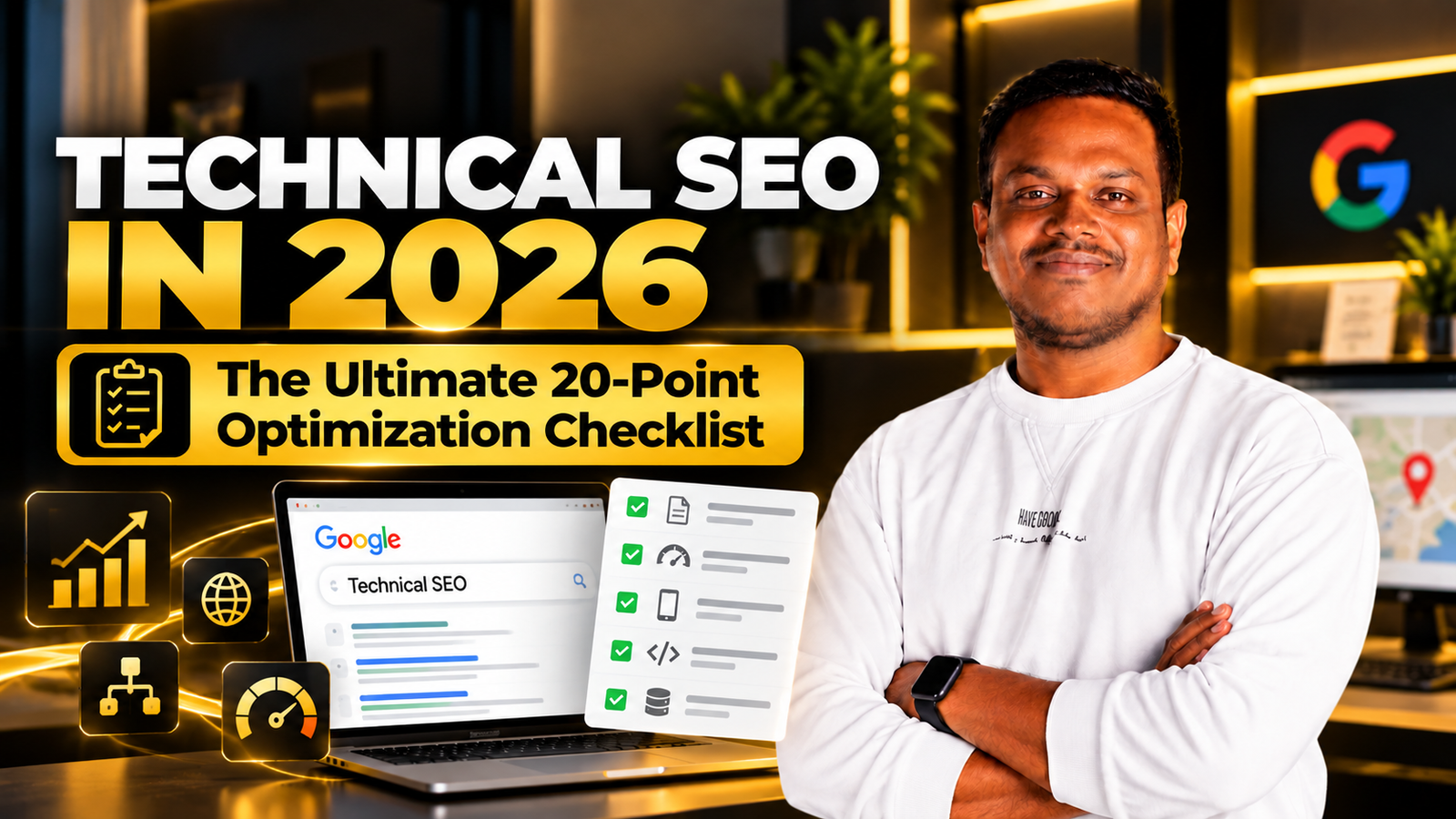
The 20-Point Modern Technical SEO Checklist
Here is the complete 20-point optimization framework I implement for healthcare and NEMT businesses to ensure search engines and AI bots index their high-value revenue pages:
✓
Check 01
Check Crawlability
Can Google actually access your important pages? Check robots.txt, server errors, authentication restrictions, redirects, and crawl directives. Prioritize revenue-producing service and location pages.
✓
Check 02
Verify Indexation
Crawled does not automatically mean indexed. Use Google Search Console and URL Inspection to check important URLs instead of assuming every published page is eligible to appear in Search.
✓
Check 03
Review Robots.txt
A poorly configured robots.txt file can unintentionally restrict crawler access. Make sure important website resources, CSS, scripts, and commercial sections are not blocked accidentally.
✓
Check 04
Keep Your XML Sitemap Clean
Your sitemap should focus on canonical, indexable URLs such as service pages, important location pages, useful articles, and authority content. Do not treat the sitemap as a dump of every URL your CMS generates.
✓
Check 05
Fix Canonicalization
Review duplicate or near-duplicate URLs caused by parameters, HTTP/HTTPS versions, www/non-www variations, trailing slashes, archives, or CMS behavior. Your canonical configuration must clearly communicate the preferred version.
✓
Check 06
Check Noindex Directives
An accidental noindex header or tag can completely drop an important page from Google. Always audit this after redesigns, migrations, staging pushes, plugin updates, and major development changes.
✓
Check 07
Improve Core Web Vitals (LCP, INP, CLS)
Focus on real usability problems rather than chasing an arbitrary 100/100 score. Resolve oversized imagery, heavy unminified scripts, unexpected layout shifts, and slow hosting server responses.
✓
Check 08
Prioritize Mobile Experience & Touch Targets
Test call buttons, navigation menus, booking forms, font sizes, tap targets, and CTAs. For an NEMT customer trying to arrange transport on a smartphone, finding the call button in 2 seconds matters more than fancy animations.
✓
Check 09
Use HTTPS & SSL Correctly
Check for certificate renewals, mixed content warnings, insecure HTTP asset links, and avoid lengthy HTTP-to-HTTPS redirect chains.
✓
Check 10
Fix Broken URLs (404s) & Redirect Chains
When URLs change, redirect users via 301 to the most closely related replacement page and update internal links. Do not redirect every old URL to the homepage indiscriminately.
✓
Check 11
Build Logical Site Architecture & Hierarchy
Clear folder relationships: SEO → Local SEO → Local SEO for NEMT; or Google Ads → Google Ads for Pediatricians. Core commercial pages must never be buried 4+ clicks deep without contextual links.
✓
Check 12
Improve Contextual Internal Linking
Connect supporting content to money pages. For example, an article about private-pay NEMT growth should naturally link to Google Ads for NEMT, Local SEO for NEMT, and AI Search Optimization services.
✓
Check 13
Test JavaScript-Dependent Content & Rendering
Google renders JavaScript, but server-rendered or clean HTML ensures zero rendering delays or missing content snippets in Search and generative AI bots.
✓
Check 14
Implement Rich Structured Data (Schema.org)
Deploy Organization, LocalBusiness, MedicalBusiness, Article, FAQPage, and BreadcrumbList markup. Schema should describe real business facts, not manufacture misleading claims.
✓
Check 15
Optimize Images & Visual Search (Google Lens)
Modern WebP formats, responsive srcset, descriptive filenames, contextual alt text, and lazy loading. Multimodal visual searches via Google Lens and Circle to Search are now tracked in Search Console.
✓
Check 16
Control Thin, Filter & Duplicate URLs
Prevent CMS sprawl from tag archives, internal search queries, or parameter variants. Do not spam duplicate city pages with identical text just by changing the Florida town name.
✓
Check 17
Monitor HTTP Status Codes & Server Health
Eliminate server 500/503 downtime, soft 404s, and redirect loops. If Googlebot or patient families hit server crashes, no amount of keywords will rescue conversions.
✓
Check 18
Strengthen Entity Consistency (Knowledge Graph)
Clarify who you are, what you provide, who you serve, and where you operate. Consistent NAP (Name, Address, Phone) and authoritative digital footprints across Google, Bing, and health directories.
✓
Check 19
Prepare for AI Search (Google AI, ChatGPT, Copilot)
Start with crawlable, fast pages, authoritative topical depth, clear entities, and structured data. Generative AI engines cite and summarize trusted, well-architected sources.
✓
Check 20
Measure Acquisition Metrics After Optimization
Audit real business impact: Crawlability → Indexation → Visibility → Relevant Visits → Calls & Form Inquiries → Private-Pay Patients.
Industry Applications: NEMT & Pediatric Clinics
Technical SEO for NEMT Companies in Florida
An NEMT website must clearly differentiate services for search engines: wheelchair transportation, stretcher transportation, ambulatory transportation, hospital discharges, and dialysis recurring rides.
If a provider serves Broward and Miami-Dade, the architecture must communicate that exact geographic hierarchy:
NEMT Provider → Wheelchair Transportation → Broward & Miami-Dade → Transportation Inquiry
Technical SEO for Independent Pediatric Practices
Parents search for newborn checkups, sick visits, ADHD evaluations, and practices accepting new insurance. The website architecture must clearly link doctors, clinical services, physical offices, and online appointment booking paths.
Florida Regional Geography Matters
Florida is not a single market. A South Florida business might serve Fort Lauderdale, Hollywood, Pembroke Pines, Miramar, Weston, Miami, and Coral Springs, while another serves Tampa or Orlando. Align your technical indexation with genuine operating zones.
Frequently Asked Questions
Q. What is technical SEO in 2026?
Technical SEO helps search engines crawl, render, understand, and index a website while supporting a fast, secure, and intuitive experience for human visitors.
Q. Does technical SEO help Local SEO?
Yes. Crawlability, indexation, clean architecture, performance, and internal links directly support the high-intent location and service landing pages essential for ranking on Google Maps and Local 3-Packs.
Q. Can technical SEO help with Google AI Search & ChatGPT?
Yes. Generative AI engines rely on crawlable pages, structured data schemas, clear entities, and semantic relationships to understand and cite your healthcare business in AI Overviews and answers.
Q. How often should a technical SEO audit be conducted?
Audits are critical after migrations, redesigns, major CMS or plugin updates, drops in organic inquiries, or whenever you launch new commercial service areas.
FREE 20-POINT AUDIT
Is Your Website Leaking Private-Pay Patient Bookings?
Get a comprehensive, non-automated Technical SEO & Local AI Search audit for your Florida NEMT or healthcare business. Identify indexing barriers and uncover untapped patient demand.